Printable Character Reference Letter for Child Custody Template
When navigating the complexities of child custody arrangements, a Character Reference Letter can play a pivotal role in influencing the court's decision. This letter serves as a powerful testament to a parent's character, highlighting their suitability as a caregiver. It provides insight into the individual's parenting style, emotional stability, and overall commitment to their child's well-being. Typically written by family members, friends, or colleagues, the letter should reflect personal observations and experiences that illustrate the parent's nurturing qualities. A well-crafted Character Reference Letter not only emphasizes the parent's strengths but also addresses their relationship with the child, showcasing the bond they share. The court values these letters because they offer a unique perspective that formal documents cannot provide. Therefore, understanding how to create an impactful letter is essential for anyone involved in a custody dispute. By focusing on specific examples and genuine sentiments, the letter can significantly bolster a parent's case, making it a critical component of the custody process.
Similar forms
The Character Reference Letter for Child Custody shares similarities with a Personal Reference Letter. Both documents aim to provide insight into an individual's character and suitability for a specific role or responsibility. A Personal Reference Letter often highlights personal qualities, experiences, and relationships, which can also be relevant in a custody situation. Each letter serves to support a person's case by showcasing their positive traits and their ability to provide a stable environment.
Another document that aligns closely is the Affidavit of Support. This legal document is often used in immigration cases, but it also serves to affirm a person's ability to support another individual. Like the Character Reference Letter, it emphasizes the individual's reliability and commitment to providing for someone else's well-being. Both documents require a demonstration of trustworthiness and the capacity to fulfill obligations.
The Parenting Plan is also comparable, as it outlines the responsibilities and arrangements for child custody. While the Character Reference Letter focuses on character traits, the Parenting Plan details how those traits translate into actionable commitments. Both documents ultimately aim to ensure the best interests of the child are prioritized, reflecting the parent's ability to provide a nurturing environment.
For those looking to effectively showcase their qualifications, utilizing a professional Recommendation Letter form can be invaluable. This type of document not only supports an application but also provides insight into the individual’s strengths and attributes, making it a crucial resource in various contexts.
Letters of Recommendation for Employment share a similar purpose in assessing character and qualifications. These letters provide insight into an individual's work ethic and reliability, qualities that are also crucial in custody cases. Both documents offer a perspective on the individual's ability to fulfill responsibilities, whether in a professional setting or as a parent.
Finally, a Support Letter for a Court Case can be seen as analogous to the Character Reference Letter for Child Custody. This type of letter is intended to support a party in a legal matter by vouching for their character and reliability. Both documents serve to influence the court's perception of the individual, aiming to demonstrate their suitability for the responsibilities they are seeking to uphold.
Document Overview
| Fact Name | Description |
|---|---|
| Purpose | A character reference letter for child custody is intended to provide insight into a parent's character, parenting skills, and suitability for custody. |
| Content | The letter typically includes personal anecdotes, observations of the parent-child relationship, and specific examples of the parent's positive qualities. |
| Format | There is no strict format, but it is generally recommended to include the writer's contact information, a greeting, and a closing statement. |
| Length | Character reference letters are usually one to two pages long, providing enough detail without overwhelming the reader. |
| State-Specific Forms | Some states may have specific guidelines for character reference letters in custody cases. It is important to check local court rules. |
| Governing Laws | In many states, child custody decisions are guided by the best interests of the child standard, which may be referenced in the letter. |
| Submission | The letter should be submitted to the court along with other custody documents, and it may also be shared with the opposing party. |
Other Character Reference Letter for Child Custody Templates:
Do Pet Adoption Agencies Call Your Landlord - Highlight how the applicant embodies traits like compassion and dedication as a prospective adoptive parent.
The Character Letter for Court form is a written document submitted to a court to provide insight into a person's character. Typically authored by friends, family members, or colleagues, these letters aim to portray the individual's values, behaviors, and overall reputation. To learn more about the process of creating these letters, you can refer to this resource on PDF Documents, which can play a crucial role in influencing a judge's perception during legal proceedings.
Example of a Letter of Recommendation - Creates a personal connection between you and the sorority.
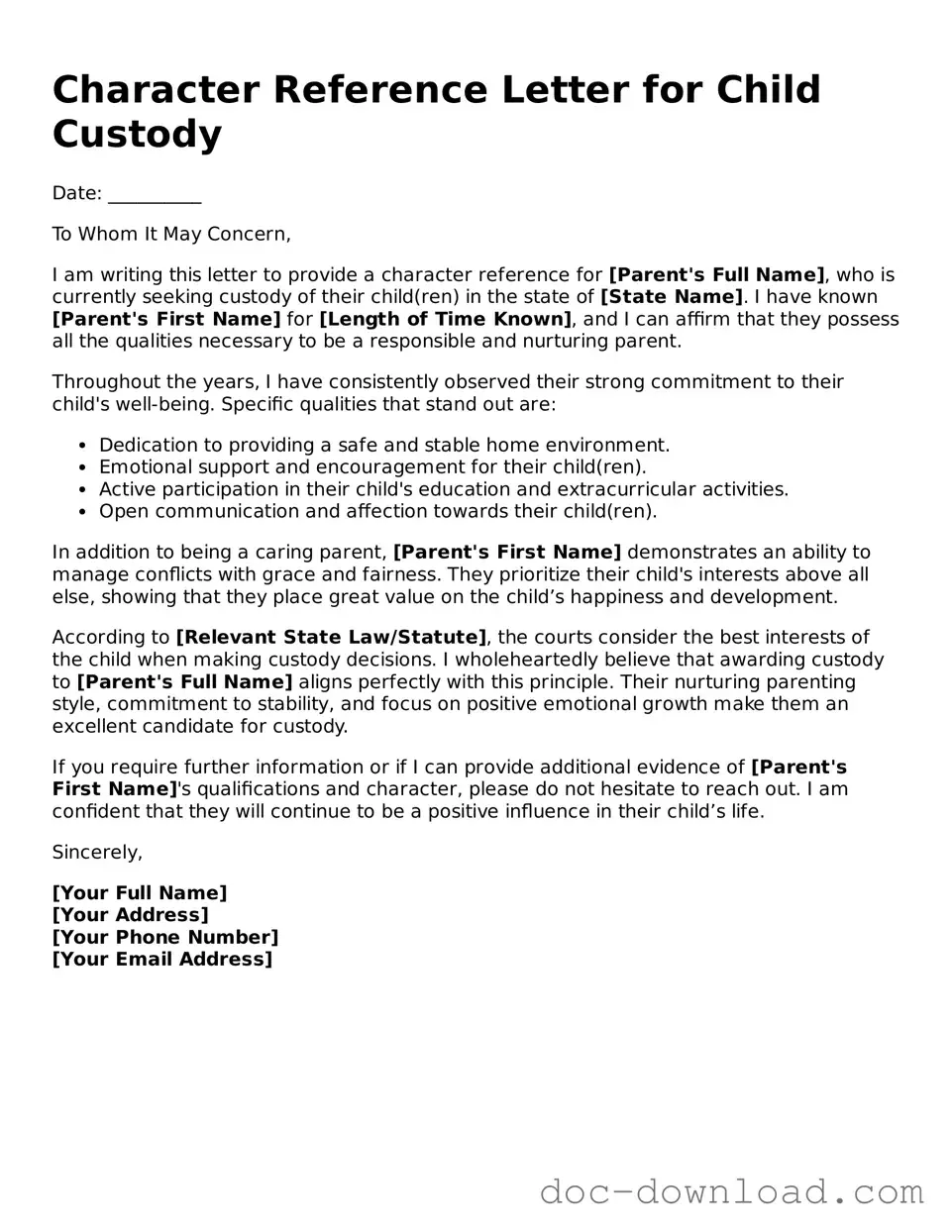
Sample - Character Reference Letter for Child Custody Form
Character Reference Letter for Child Custody
Date: __________
To Whom It May Concern,
I am writing this letter to provide a character reference for [Parent's Full Name], who is currently seeking custody of their child(ren) in the state of [State Name]. I have known [Parent's First Name] for [Length of Time Known], and I can affirm that they possess all the qualities necessary to be a responsible and nurturing parent.
Throughout the years, I have consistently observed their strong commitment to their child's well-being. Specific qualities that stand out are:
- Dedication to providing a safe and stable home environment.
- Emotional support and encouragement for their child(ren).
- Active participation in their child's education and extracurricular activities.
- Open communication and affection towards their child(ren).
In addition to being a caring parent, [Parent's First Name] demonstrates an ability to manage conflicts with grace and fairness. They prioritize their child's interests above all else, showing that they place great value on the child’s happiness and development.
According to [Relevant State Law/Statute], the courts consider the best interests of the child when making custody decisions. I wholeheartedly believe that awarding custody to [Parent's Full Name] aligns perfectly with this principle. Their nurturing parenting style, commitment to stability, and focus on positive emotional growth make them an excellent candidate for custody.
If you require further information or if I can provide additional evidence of [Parent's First Name]'s qualifications and character, please do not hesitate to reach out. I am confident that they will continue to be a positive influence in their child’s life.
Sincerely,
[Your Full Name]
[Your Address]
[Your Phone Number]
[Your Email Address]