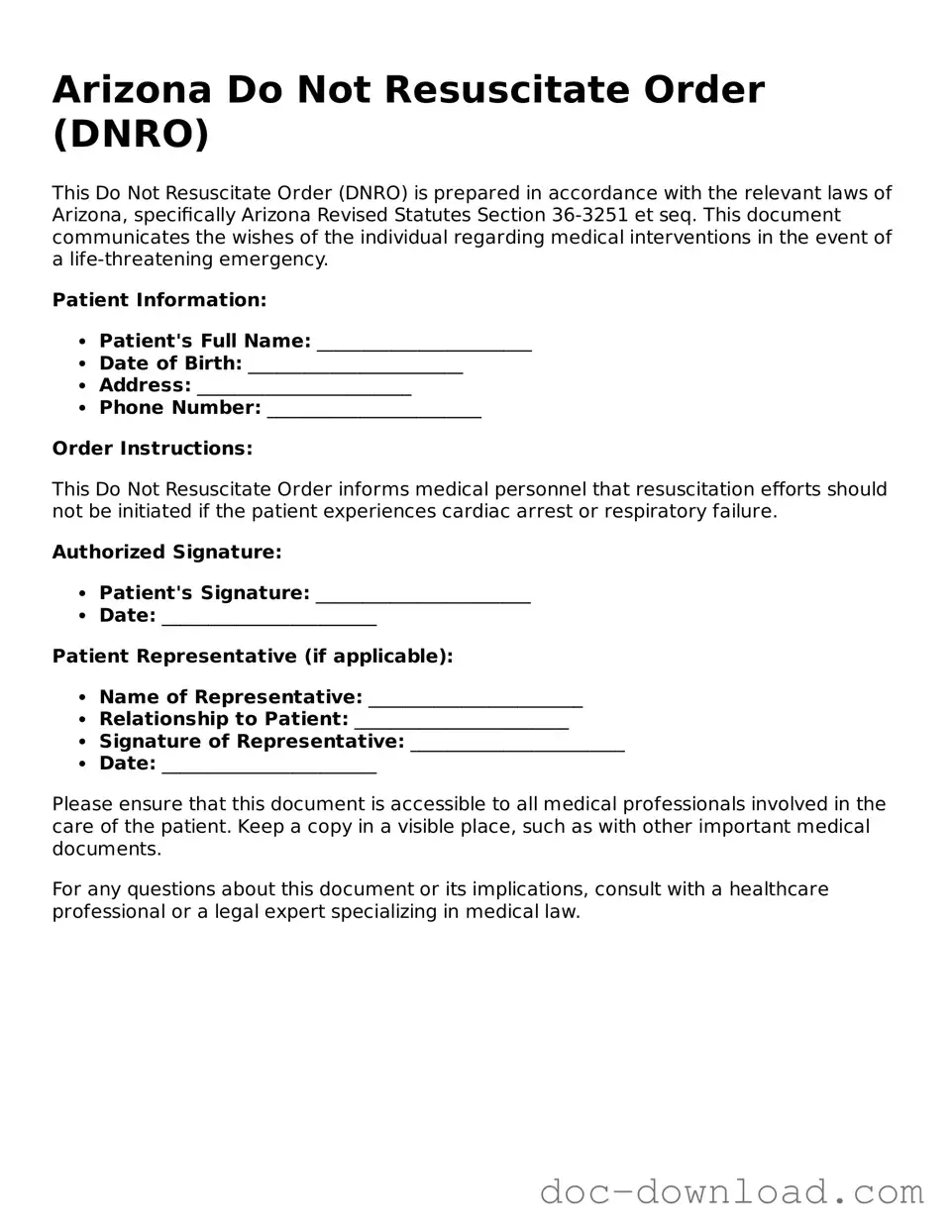
Blank Do Not Resuscitate Order Document for Arizona
In Arizona, the Do Not Resuscitate (DNR) Order form serves as a crucial document for individuals who wish to express their preferences regarding medical treatment in emergencies. This form allows patients to communicate their desire not to receive cardiopulmonary resuscitation (CPR) or other life-saving measures in the event of cardiac arrest or respiratory failure. It is designed to ensure that healthcare providers respect the wishes of patients and their families during critical moments. The DNR Order must be completed and signed by a licensed physician, and it requires the patient’s or their legal representative’s consent. This form is not only a reflection of personal values and beliefs about end-of-life care but also a vital tool for guiding medical decisions. Understanding the implications of this document is essential for anyone considering it, as it can impact the course of treatment in emergency situations.
Similar forms
The Arizona Do Not Resuscitate (DNR) Order form shares similarities with a Living Will. A Living Will is a legal document that outlines a person's preferences regarding medical treatment in situations where they are unable to communicate their wishes. Both documents serve to express an individual's desires about end-of-life care. While the DNR specifically addresses resuscitation efforts, the Living Will covers a broader range of medical interventions, including life support and artificial nutrition. This ensures that a person's wishes are respected in critical medical situations.
When considering the transfer of real estate, understanding the different documentation options is essential. For instance, a Florida Quitclaim Deed is commonly used for transferring ownership without title guarantees, often in familial scenarios. For more information about this process, visit quitclaimdeedtemplate.com/florida-quitclaim-deed-template/.
Another document comparable to the Arizona DNR Order is the Medical Power of Attorney. This document allows an individual to designate someone else to make medical decisions on their behalf if they become incapacitated. Like the DNR, the Medical Power of Attorney aims to ensure that a person's healthcare preferences are honored. However, the Medical Power of Attorney can encompass a wider array of decisions beyond resuscitation, including the acceptance or refusal of various treatments. Both documents work together to provide a comprehensive approach to medical decision-making.
The Physician Orders for Life-Sustaining Treatment (POLST) form is also similar to the Arizona DNR Order. The POLST is a medical order that translates a patient's wishes regarding life-sustaining treatments into actionable medical directives. While the DNR specifically focuses on resuscitation, the POLST addresses a broader spectrum of treatment options, including the use of antibiotics and feeding tubes. Both documents are intended for individuals with serious health conditions, ensuring that their treatment preferences are clearly communicated to healthcare providers.
Finally, the Advance Directive is another document that resembles the Arizona DNR Order. An Advance Directive is a broader term that encompasses both Living Wills and Medical Powers of Attorney. It allows individuals to outline their healthcare preferences and appoint someone to make decisions on their behalf. Similar to the DNR, the Advance Directive ensures that a person's wishes regarding medical treatment are respected, particularly in situations where they cannot express their desires. This comprehensive approach helps to clarify an individual's intentions regarding end-of-life care.
Document Overview
| Fact Name | Description |
|---|---|
| Legal Basis | The Arizona Do Not Resuscitate Order form is governed by Arizona Revised Statutes, specifically A.R.S. § 36-3201 et seq. |
| Purpose | This form allows individuals to express their wishes regarding resuscitation in the event of a medical emergency. |
| Eligibility | Any adult who is capable of making their own medical decisions can complete a Do Not Resuscitate Order in Arizona. |
| Signature Requirement | The form must be signed by the patient and a physician to be valid and recognized by medical personnel. |
Additional State-specific Do Not Resuscitate Order Forms
What Does a Dnr Look Like - Facilitates discussions between patients, families, and medical professionals.
Texas Out of Hospital Dnr - These orders can provide peace of mind by aligning medical care with personal values and preferences.
To ensure your wishes are respected after your passing, utilizing a Last Will and Testament form is essential, and it is beneficial to explore resources like Colorado PDF Forms for guidance in creating this important legal document.
Can You Get a Dnr at Any Age - Be aware that treatment preferences vary, and it's important to discuss your DNR wishes clearly with loved ones.
Sample - Arizona Do Not Resuscitate Order Form
Arizona Do Not Resuscitate Order (DNRO)
This Do Not Resuscitate Order (DNRO) is prepared in accordance with the relevant laws of Arizona, specifically Arizona Revised Statutes Section 36-3251 et seq. This document communicates the wishes of the individual regarding medical interventions in the event of a life-threatening emergency.
Patient Information:
- Patient's Full Name: _______________________
- Date of Birth: _______________________
- Address: _______________________
- Phone Number: _______________________
Order Instructions:
This Do Not Resuscitate Order informs medical personnel that resuscitation efforts should not be initiated if the patient experiences cardiac arrest or respiratory failure.
Authorized Signature:
- Patient's Signature: _______________________
- Date: _______________________
Patient Representative (if applicable):
- Name of Representative: _______________________
- Relationship to Patient: _______________________
- Signature of Representative: _______________________
- Date: _______________________
Please ensure that this document is accessible to all medical professionals involved in the care of the patient. Keep a copy in a visible place, such as with other important medical documents.
For any questions about this document or its implications, consult with a healthcare professional or a legal expert specializing in medical law.